REVIEWS
New wave from Korea
Invited Solo Exhibition
KwanHoon Gallery, 1985.
In 1982 a new era was dawning in the rarefied world of ink and rice painting in South Korea, as artists broke free of the oppressive and restrictive attitudes of the traditionalists.
Misoon Kim was at the forefront of this movement, which saw her move away from conceptual work – characterised by large-scale works with bold and swift brush strokes – and into purely abstract expressionism.
In the Spring of 1984, I witnessed the results of this new direction at an exhibition in Kyoto, Japan: “Korean Paintings – The New Generation/New Movement in Seoul.”
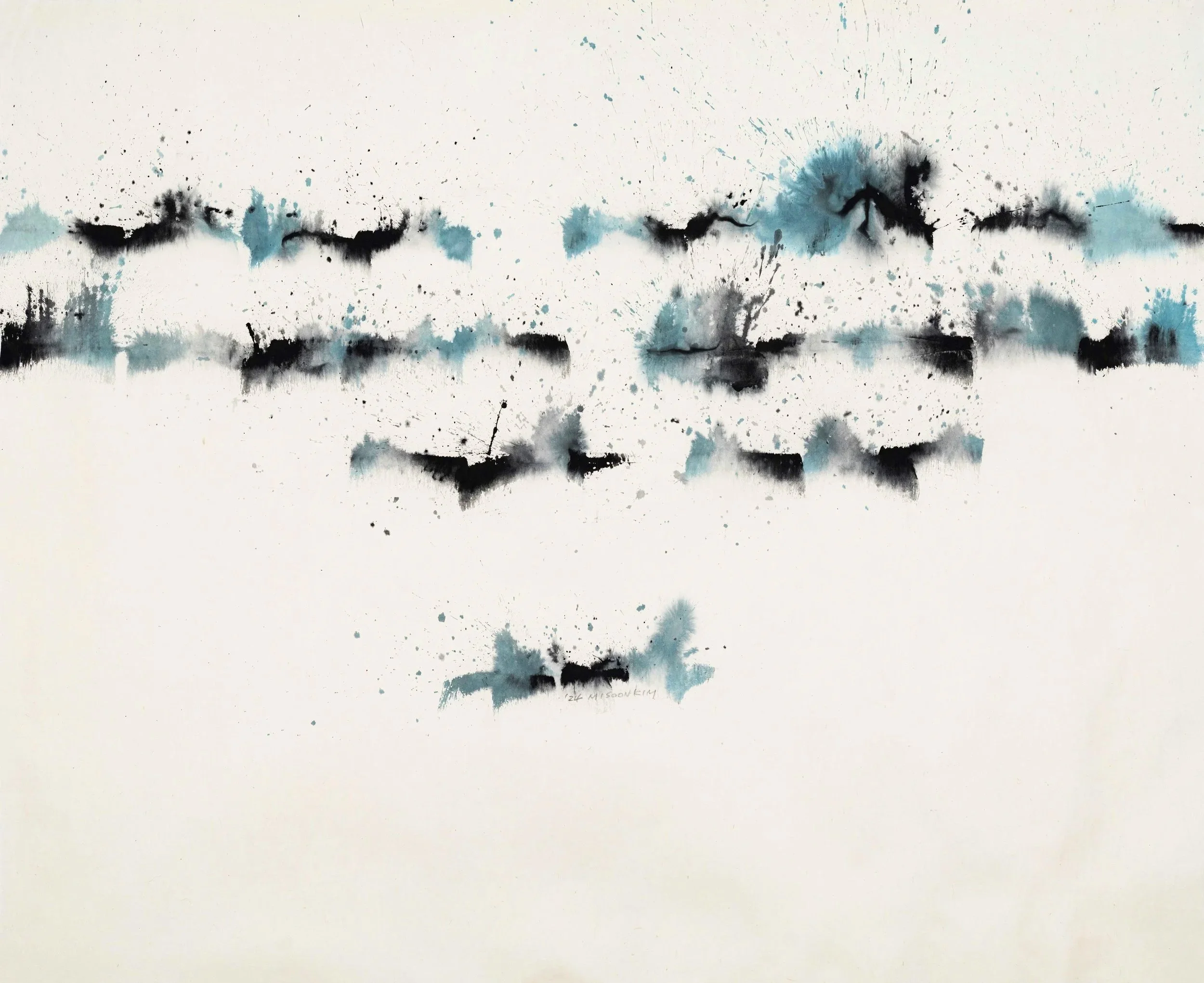
Misoon Kim’s style had developed into canvasses where dots and small strokes were arranged in symbiotic harmony with the white space of the rice paper.
Although the strokes seemed freely processed, there was an underlying subtle calculation in the form which left a deep impression. The canvasses expressed a marked individuality and reflected a keen sense of stoicism and beauty of order, with juxtaposition of bold strokes and ink wash expressing the internal and external “traces” of human behaviour.
Since then her work has continued to develop, simplifying in form, if not in content, and demonstrating a progression that points to further untapped potential for this singular and extremely talented painter.
Lee Kyong-Sung
Director
Korean Contemporary Art Museum
Dialectical Aesthetics of Creation and Destruction
Invited Solo Exhibition
Mulpa Art Center, Seoul, 2003
“ What is Neowavism in art? We should be prepared to answer such questions. Neowavism in art is based on the philosophy of Psychophysical Theory. Mulpagraphy(Neowave Art) is line art based on the oriental spirit in calligraphy and painting of the literary artist’s style. It is neither a material product of Western scientism nor a religious artifact of Oriental spiritualism. “
Dr. Son Byung Chul
Modern and Contemporary Korean Ink Paintings and Ceramics
Kang collection, New York, 2004
Misoon Kim is a well-known Korean artist. Over the past twenty years, she has exhibited extensively in Europe, Asia, and the United States.
She was at the forefront of a new movement in Korean ink painting that emerged in the early 1980s. Born in 1959, Kim lived and worked in Seoul, Paris, and New Delhi, and is currently based in New York. Reflecting a distinctive aesthetic deeply influenced by the emphasis of Zen Buddhism on simplicity and the natural world, her works embrace sensuality. They stimulate the mind and emotions to contemplate the essence of reality. Traditionally, ink represents the color of the cosmos.
In her paintings, Kim invests the color of ink with an energy that both calms and challenges viewers. Within the empty spaces that inhabit her canvases, the touch of the in-between—born from the essential human experience between darkness and light, hope and despair—achieves a sense of freedom and liberation.The 1970s and 1980s marked a return to traditional Korean ideas, if not techniques. Members of the Monochrome movement used “Korean” colors such as grey, white, and brown to create a meditative mood, while followers of the “Indian Ink” movement, such as Mi Soon Kim (b. 1959), sought to express spirituality through ink. Today, contemporary Korean ink painters draw freely upon centuries of literati ink technique and philosophy, Buddhist spirituality, the uniquely Korean landscape tradition, and international Western styles such as abstraction and expressionism to create art that reflects their unique experiences as Koreans in a globalized world.
Dr. Keumja Kang,
Director, Kang Collection
Circle of Life
Invited Solo Exhibition
Wellside Gallery, Seoul, 2021
“ Powerful and dark, or subtle and softened with water, ink strokes dance and ignite across white rice paper. Their application is a marriage of opposites—the ink born of fire and ash, and the cool purity of spring water. Bringing these elements together in the form known as ink wash painting (sumukhwa) requires profound knowledge of materials and a skill refined through decades of experimentation, practice, and discipline.
The Korean painter Misoon Kim (b. 1959) began her lifelong artistic journey with brush and ink at the age of thirteen, encouraged by her early teachers to explore the infinite variety made possible by the interaction of ink and water. Initially, she focused on building a rigorous technical foundation, mastering essential skills from the classical Chinese painting manual The Manual of the Mustard Seed Garden (芥子園畵傳) by Gai Wang. She then spent fifty uninterrupted years refining her brushwork on hanji (traditional Korean paper), developing into a true virtuoso of the medium.
Kim’s works pulsate with drama and tension. Her brushstrokes resemble clouds of ash streaking into the sky or heavy, water-soaked raindrops falling to the ground, where they writhe and twist in an apparent struggle to fuse and merge. The scale and complexity of her works allow no margin for error: every stroke is deliberate and essential, carrying its own inherent energy and imbuing even the blank spaces of the paper with tension. “
Jo Sangin,
Art Journalist, Maeil Business Newspaper
A stroke across Time and Space
Invited Solo Exhibition
Expo Art Gallery, Yeosu, 2022
Paintings on a two-dimensional plane often lead to a search for space. This is true for creators who wish to represent the three-dimensional world on a canvas and for viewers contemplating the work hanging on the wall. However, Misoon Kim’s paintings cause us to think about the flow of time above all else. Like a bird flying away through the air with the flapping of its wings, like a fish suddenly breaking through the surface before disappearing back into the water, the artist’s moving brushstrokes leave only a trace of an instant on a white surface.
With regard to these unrecognizable traces, the artist explained, “I drew it with my mother’s life in mind,” and “it expressed the relationship between people.” Having trained on the basics of oriental painting by replicating 芥子園畵譜 (The Mustard Seed Garden Manual of Painting) since she was a girl of 13 years, she practiced painting real scenery landscapes and portraits but quickly moved on to abstraction. It is likely not irrelevant that she perceived the contradictory duality of the world of phenomenon and looking beyond it. Kim had early insight into the fact that deep love evokes sadness and that beings with a living body have no choice but to experience the threshold of death. Her paintings thus yearn for the form of invisible potential that transcends the visible world. The moment the brush drenched in ink crosses time and space, the traces it leaves on the white ricepaper suggest nothing less than freedom without borders.
Dr. Lim Eunmin,
Curator
Misoon Kim’s Single Stroke: Primal Vitality Beyond Painting and Calligraphy
Invited Solo Exhibition
Welside Gallery, Seoul, 2024
“ Misoon Kim captures the vital energy and will that precede the very birth of calligraphy and painting, attempting brushwork that negates and transcends their differentiation
The musical unfolding that emerges across all of Misoon Kim’s pictorial fields is clearly bound up with breath. Canvases that reveal the rhythmic respiration of inhalation and exhalation contain dramatic resonance and narrative landscapes through only a handful of dots and lines
As though an ancient time were ruptured and the movement of a tiny creature released endless ripples and resonances, Misoon Kim’s explosive, improvised, and momentary breath—at the far edge of silence, in connection with primordial strata of time—harbors the duration of eternity and spreads without end beyond the vast white blankness. ”
Lee Kun-soo
Art Critic, Exhibition Curator